
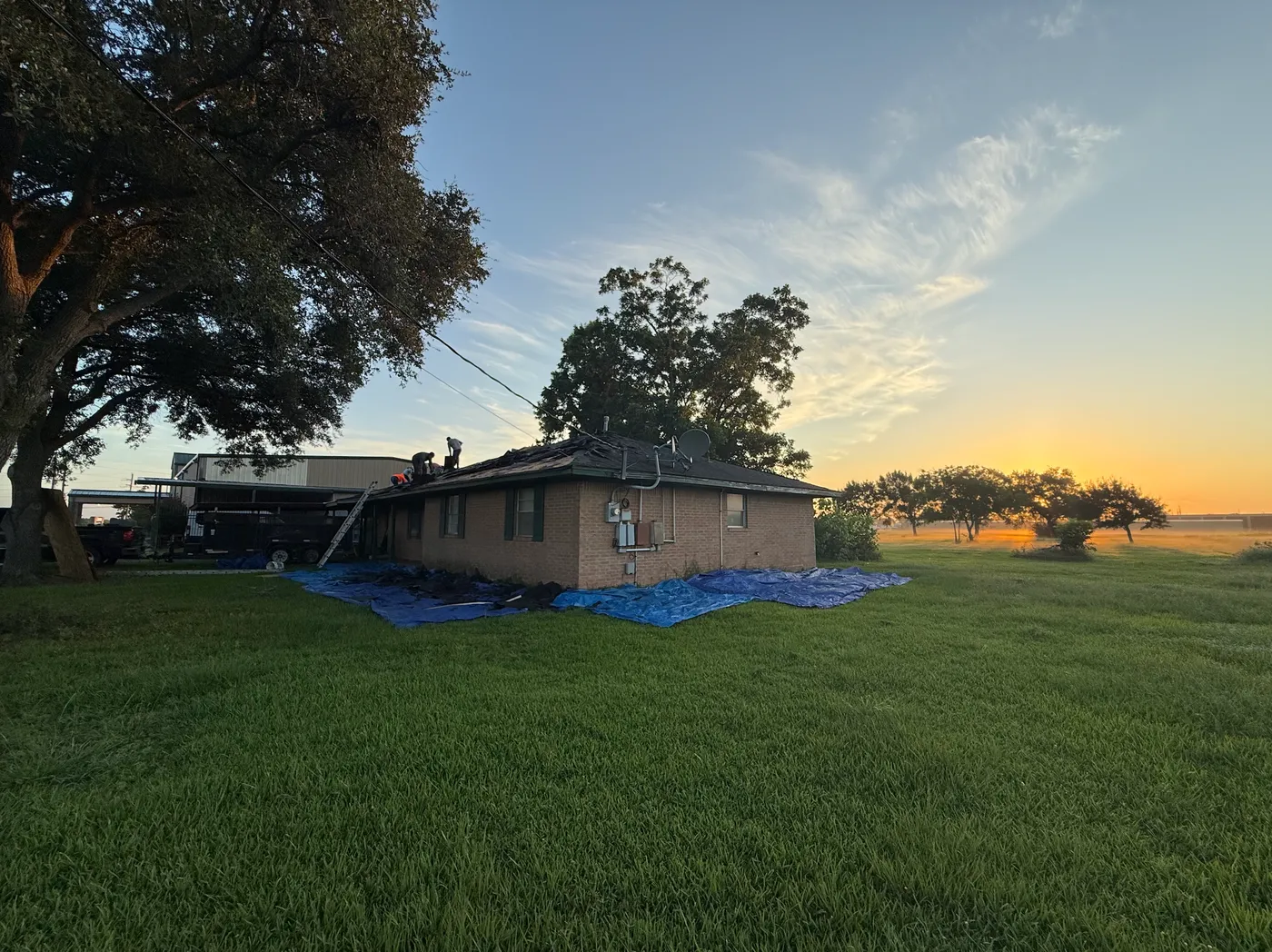
The storms this area actually sees
You don't have to take a roofer's word for the risk — it's in the federal record. The National Weather Service puts southeast Texas at 50–60 thunderstorm days a year, about a third with severe weather. NOAA's Storm Events Database logs damaging hail (¾-inch and larger) in Montgomery County nearly every year — one-inch hail near Shenandoah as recently as June 2025 — plus estimated 75+ mph thunderstorm winds in the south county in May 2025. Hurricane Beryl (July 2024) drove a measured 69 mph gust at Conroe, well inland; the May 2024 derecho tore through the Houston metro with winds estimated near 100 mph in places (the recorded extremes were down toward Houston — Montgomery County's logged winds ran lower); and Harvey dropped 25.66 inches of rain on The Woodlands itself. Storms are the operating environment here — the question is whether your roof's next one finds a weak seal.
What hail and wind damage actually look like
- Hail: fresh dents in gutters, downspouts and gutter aprons; dings on A/C condenser fins (a useful size proxy — photograph them); dark 'bruises' on shingles where granules crushed into the mat.
- Wind: creased or folded shingle tabs, lifted ridge caps, torn shingles at roof edges and corners where uplift concentrates. IBHS research is blunt — the sealant bond is what fails, and it fails easier as roofs age.
- The compounding problem: IBHS testing shows repeated sub-severe hail (0.7–1.0 inch) plus normal weathering makes shingles behave like decade-older material. A roof can be storm-weakened without one dramatic 'totaled' moment.
- Falling limbs: puncture and crush damage — common on preserve-edge and heavily-treed lots in villages like Indian Springs, Grogan's Mill and Creekside Park.
What to do — and what NOT to do — after a storm
- Stop active water with emergency tarping (we do this first, questions later).
- Get a documented inspection BEFORE filing — a denied claim helps no one. We tell you plainly if the damage doesn't justify a claim.
- Know the law before anyone knocks: Texas made it illegal for contractors to pay, waive, or absorb your deductible (Tex. Ins. Code §707.002; Bus. & Com. Code §27.02) — TDI warns violators face fines and jail, and your insurer can require proof you paid it before releasing full claim funds. Anyone offering to 'eat the deductible' is proposing fraud with your name on it. See our insurance claims guide.
- Be wary of storm chasers: TDI's own guidance says it's against the law for out-of-town contractors to demand a down payment before starting after a disaster, recommends getting multiple bids, and warns against contracts that assign work 'for the value of insurance proceeds.'
- If you file: Texas prompt-payment law (Ins. Code Ch. 542) requires your insurer to acknowledge the claim within 15 days, decide within 15 business days of having what it needs, and pay within 5 business days of accepting — with extensions in declared catastrophes.
Our claim-ready documentation
Insurance decisions run on evidence. Every storm assessment we do in The Woodlands produces a forty-photo minimum packet — every slope, every penetration, close-ups of damage, soft-metal hail indicators — plus a written scope aligned to the line items adjusters work from. We'll attend the adjuster's inspection on request. And we stay on our side of the legal line: Texas law (Ins. Code §4102.163) prohibits a roofer from acting as your public adjuster, so we document and build; negotiation is yours or a licensed PA's.
Looking for how we handle this service everywhere we work? See the full storm damage guide.